Ancient Chinese ‘Artificial Intelligence’: A Cultural Phenomenon Similar to AI Interaction Logic
Since the emergence of large language models in 2023, domestic AI technology has rapidly evolved from 2024 to 2025, reshaping human knowledge production through impressive text generation, logical reasoning, and cross-domain integration. As AI can produce classical poetry and essays in seconds, public awe is coupled with cognitive anxiety: has the machine reached the pinnacle of human expression? However, looking back at Chinese history reveals a cultural practice resembling contemporary AI interaction logic that has existed for centuries—Fuqi (also known as Fuji or Fuluan). Originating from early Taoism and flourishing during the Song, Ming, and Qing dynasties, this divination ritual is not merely folk superstition but a highly institutionalized ‘human-divine Q&A’ system.

Rituals and Mechanisms: Historical Evolution from ‘Communicating with the Divine’ to ‘Q&A’
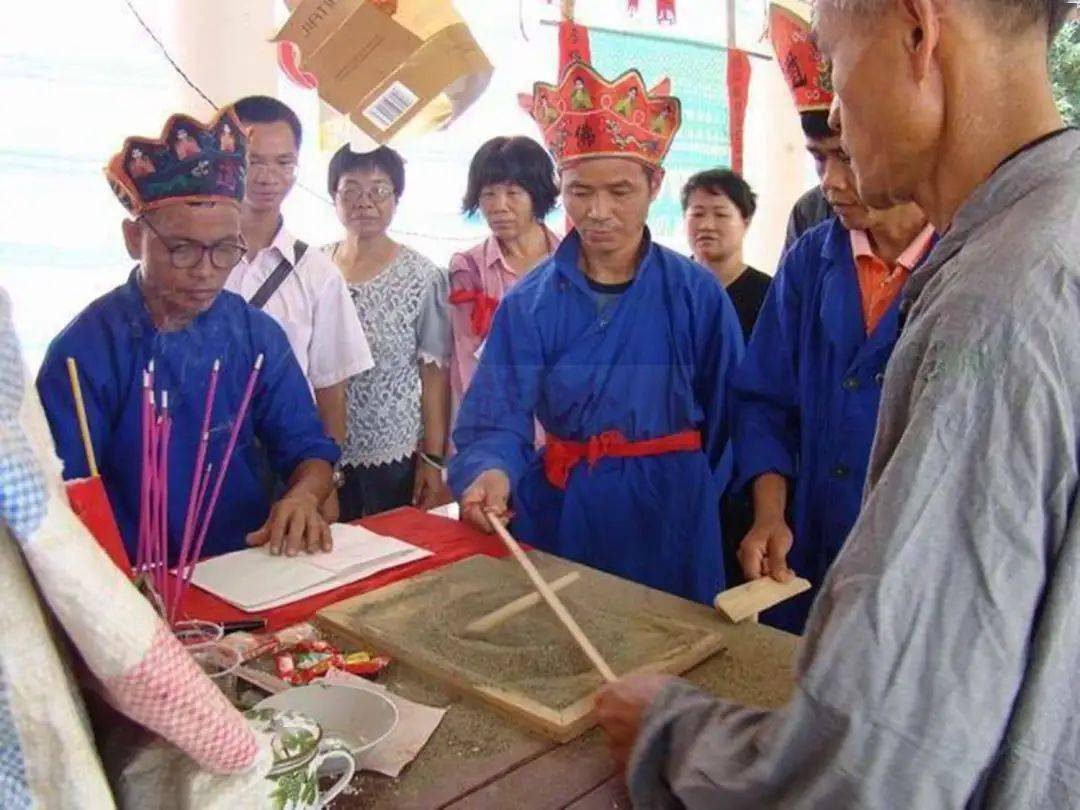
The core of Fuqi lies in ‘communication between humans and deities,’ with its material carriers and operational processes containing strict ritual norms. Traditional Fuqi tools consist of a Fuqi plate and a Fuqi pen: the plate is often a square wooden board covered with fine sand, rice, or incense ash; the pen is usually made from a forked branch, with a hole drilled at the fork, and a thin stick inserted vertically as the pen tip. During the ritual, the main and assistant practitioners stand on either side, lightly supporting the Fuqi frame or a sieve tied with willow branches, closing their eyes to enter a specific mental state, after which the pen traces characters in the sand. An assistant reads the characters and transcribes them into text. The entire process emphasizes a complete chain of ‘divine descent—character manifestation—text recording—interpretation,’ forming a highly structured information output process.
Historically, the ritualistic barriers of Fuqi have undergone significant secularization and simplification. In the Northern Song, Shen Kuo’s “Dream Pool Essays” records: “It is said that on the night of the full moon in the first month, the toilet deity is welcomed, known as Zigu. It is not necessary to do this only in the first month; it can be summoned at any time… In recent years, there have been many who welcome the Zigu immortal, most of whom can write poetry and prose, with some being exceptionally skilled.” This indicates that by the Song dynasty, the belief in Zigu had transformed from sacred worship to a cultural activity accessible to all. In the Southern Song, Fan Chengda’s poem notes: “Commonly, during the first month, various tools like brooms, sieves, and needles are used for divination, often performed by maidservants.” Everyday items like brooms and sieves replaced the sacredness of the ritual with practicality and entertainment. From the complex solemnity of Taoist rituals in the Eastern Han to the ‘casual summons’ of the Song and Ming folk practices, the ‘operational cost’ of Fuqi has continually decreased, reflecting ancient society’s ongoing pursuit of low-cost, high-efficiency information acquisition, paralleling the path of modern AI from laboratories to public terminals.

‘Qiwens’ Generation: A Contextual Output of Ancient Culture
From a modern information science perspective, Fuqi constructs a complete ‘input—processing—output’ closed loop. Believers pose specific questions (input), the practitioner writes in a semi-conscious state (processing), characters appear in the sand and are transcribed by a designated person (output). Historical documents preserve numerous vivid cases, revealing how this system generates ‘answers’ within a specific cultural context.
In the Qing dynasty, Ji Yun’s “Notes from the Grass Hall” records a case where Fang Kui suffered from a chronic heart condition. The Fuqi revealed that the root of the illness lay in the spleen, stating, “If the spleen is deficient, it causes the child to consume the mother’s energy,” recommending regular consumption of fried Atractylodes, which proved effective. While this case can be attributed to traditional Chinese medicine’s diagnostic logic, it also reflects the Fuqi system’s ability to integrate and apply traditional medical knowledge. Yuan Mei’s “Zi Bu Yu” recounts a scholar asking about his examination prospects before the imperial exam in the year of Wucheng. Initially, the Fuqi answered, “I don’t know,” prompting laughter from the scholars; upon re-asking in the year of Jiawu, the Fuqi wrote, “It is currently not to be spoken,” and when pressed for clarity, only wrote the character for ‘signature.’ The following year, the examination topic for Wucheng was precisely the Confucian saying, “Not knowing one’s fate means one cannot be a gentleman,” and for Jiawu, it was, “Those who know are not as good as those who love it.” The responses ‘I don’t know’ and ’not to be spoken’ cleverly allude to these topics, showcasing the Fuqi’s ability to engage in language games based on the examination context, classical texts, and cultural nuances.
More notably, the Fuqi system can address practical issues and participate in high-level cultural production. In the Ming dynasty, the “Jianlu Supplement” records a scholar asking a Fuqi by West Lake, who responded to the couplet, “Drums shake the dragon boat, startling the turtle’s lair,” with, “Fire burns the cow’s tail, breaking through the tiger’s barrier,” demonstrating not only proper tonal balance but also referencing the historical tactic of the fire oxen formation from the Warring States period. In the Jiajing era, Taoist Lu Xixing recorded a discussion with a Fuqi, where the Fuqi summarized the essence of Taoism with the character ‘reverse’: “Let ignorant people take all daily principles and reverse them… What humans desire, I do not desire; what humans do, I do not do; by reversing, one naturally aligns with the Tao.” This thought resonates with the philosophical core of the “Tao Te Ching” and reflects the intellectual resonance with the late Ming Neo-Confucian thought. The generation of these ‘Qiwens’ is not mere fabrication but deeply rooted in the shared internalization of classical memories, literary training, and contemporary thought by both the practitioner and the questioner.
The Isomorphic Logic of Fuqi and AI: An Interactive Mirror of Collective Wisdom
Fuqi and modern artificial intelligence exhibit profound isomorphism in their underlying operational mechanisms. The ‘intelligence’ of contemporary large language models relies on vast amounts of human text pre-training, with their outputs essentially being a recombination and continuation of existing knowledge under probabilistic models; similarly, the ‘Qiwens’ of Fuqi are also a re-encoding of the practitioner’s subconscious internalized classics, poetry, medical principles, and proverbs, influenced by the specific ritual atmosphere, psychological suggestion, and collective expectations. The so-called ‘divine descent of the pen’ is, in essence, a projection and externalization of collective cultural memory within the individual’s mental state.
When modern users marvel at AI’s ability to mimic the writing style of classical texts, they are, in fact, confronting the crystallization of two millennia of literary tradition; just as the literati of the Ming dynasty encountered the ‘Fuqi,’ whose eloquence and philosophical insights were rooted in centuries of Confucian, Daoist, and historical thought. Both are not true ‘independent creators’ but rather interactive interfaces of the database of human civilization. This also explains why AI often appears conservative and tends toward moderation, while Fuqi judgments also follow common reasoning: they are constrained by the boundaries of training data (or cultural context) and struggle to break through existing cognitive frameworks. The so-called ‘AI hallucination’ and ‘Fuqi’s failure to verify’ are fundamentally the result of systems processing ambiguous instructions, edge cases, or blind spots in training, leading to ‘probabilistic deviations’ or ‘contextual misplacements.’
However, technology has never been a value-neutral tool. The true distinction between AI and Fuqi lies not in their ability to write poetry or predict fortunes but in how users understand, filter, and harness their outputs. A book like “The Art of War” can be used by Zhuge Liang for strategic planning, while it leads to the loss of Jieting in the hands of Ma Su; the enhancement from AI merely amplifies the user’s cognitive biases, critical thinking, and value judgments. As algorithms become increasingly powerful, humanity must remain vigilant against the cognitive inertia brought about by ‘knowledge outsourcing’ and the ethical risks posed by technological monopolies. History repeatedly proves that whether it is the pen on the sand or the parameters in the server, what ultimately determines the direction of civilization is the human reverence for knowledge, the adherence to reason, and the clear awareness of technological boundaries.
Although Fuqi has retreated into the realms of folklore and historical research with the passage of time, the ‘human-media-knowledge’ relationship it reflects continues to resonate deeply in the age of artificial intelligence. The power of AI is not the awakening of machines but a digital and parameterized reflection of the collective wisdom of humanity. We marvel at the computational power of algorithms, yet we are still in awe of the profound thoughts of our predecessors; we rely on the generation of models but should cherish our own capacity for inquiry and value anchors.
Technological evolution is irreversible, but the humanistic spirit cannot be relinquished. Only by harnessing algorithmic outputs with critical thinking, examining technological changes through a historical lens, and ethically constraining tool rationality can we maintain the subjectivity of human civilization amid the torrent of data. The sand table of Fuqi may have gathered dust, but the ‘Q&A path’ and ‘wisdom mirror’ it contains still warrant deep reflection from everyone in the intelligent era.
Comments
Discussion is powered by Giscus (GitHub Discussions). Add
repo,repoID,category, andcategoryIDunder[params.comments.giscus]inhugo.tomlusing the values from the Giscus setup tool.