 Guohao Li quickly acquired the desired open-work.ai domain after the release of Claude Cowork. With a background from KAUST and Oxford, he is a top Chinese scholar who has worked at Intel and Kumo AI, embodying a golden blend of academia and business.
Previously, his team had spent years developing the Camel AI framework, successfully productizing it into Eigent and launching it to the community. However, before they could celebrate, they were overshadowed by Anthropic’s Claude Cowork.
 Feeling overwhelmed, Guohao Li made a bold decision: he fully open-sourced the Eigent project on GitHub under the Apache 2.0 license, allowing everything to be freely available. He confidently stated, “I don’t care!”
 Thomas Wolf, co-founder of Hugging Face, praised the move, igniting enthusiasm within the community.

Killing the Monolithic Agent Fantasy
What truly impressed the open-source agent community was Guohao Li’s engineering reconstruction of the multi-agent architecture. Starting from the CAMEL foundation, he built an efficient workforce system that supports execution, fault tolerance, and recursion, effectively turning research into a desktop productivity tool.
 GitHub link:
https://github.com/eigent-ai/eigent
For the past two years, agents primarily engaged in cosplay, mimicking roles such as teacher and student. However, the CAMEL-AI framework introduced a new design concept: distributed systems. In this architecture, agents become infinitely scalable computing nodes, with multiple agents viewed as a computing cluster.
 Guohao Li emphasized that the problem they are solving is not about “how to chat better,” but rather “how to organize multiple AIs to collaborate in parallel like engineering teams, even exploring large-scale (hundreds of) agent task parallelism.”
The project that garnered praise from Karpathy is called SETA: Scaling Environments for Terminal Agents. This is the real game-changer.
 Previously, agents output text code in dialogue boxes; now, agents directly take over the terminal, executing operations, debugging environments, and deploying services like hackers.
Mastering the terminal equates to gaining control over the computer’s underlying operations.
Google’s developer blog hailed this as “Next Generation Agents.”
 This is not mere commercial flattery. Google recognizes that this architecture allows AI to step out of the comfort zone of “text generation” and into the deep waters of “environment interaction.”
Guohao Li is transforming agents into a new form of “silicon-based labor,” equipped with organizational structures and tools to get the job done. This explains why xAI reached out with an invitation; if this architecture succeeds, existing SaaS software models will be completely disrupted.
 Interestingly, in the face of offers from giants and market demand, Guohao Li made a counterintuitive choice. He did not rush to secure funding for monetization but opted for a more challenging path.
Tired of Black Box SaaS
We Want Our Own Agent
Guohao Li once thought he was doomed, admitting, “I thought I would be killed by Cowork.” But the outcome was entirely different. The market data revealed that developers did not need another black box SaaS subscription service; they needed ownership.
Thus, he unleashed his ultimate weapon: the strongest full-stack local agent. From foundational model inference to UI, sandbox runtime, and distributed scheduling, everything is open-sourced under Apache 2.0, ready to be taken away.
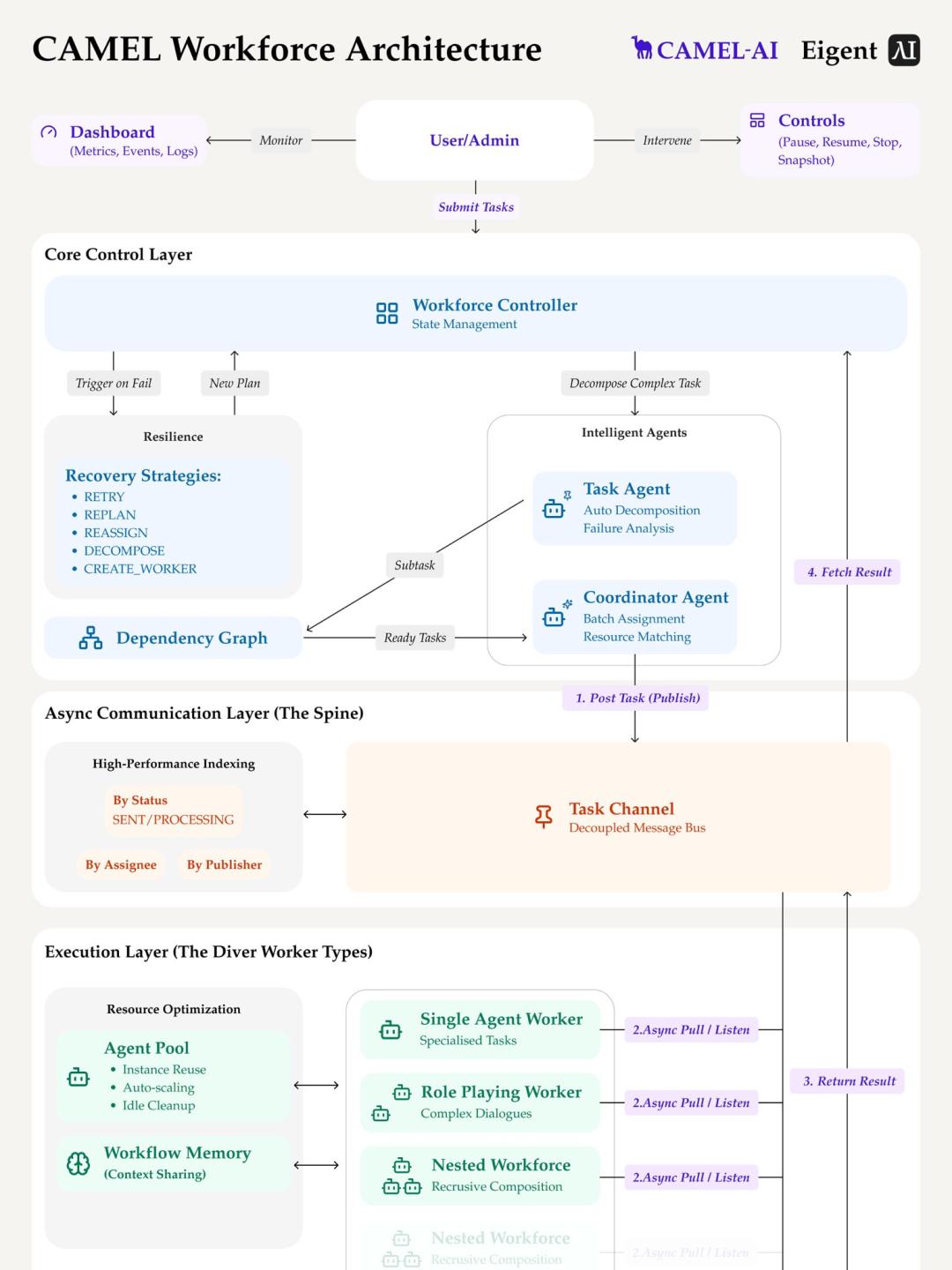
Architecture Layer: Distributed Message Bus, Smooth and Reliable
He completely discarded the traditional “linear call” approach in favor of a distributed actor model with a structured message bus, making fault tolerance, restart, and scaling as smooth as microservices.
This distributed design inherently possesses fault tolerance. If an agent responsible for “code review” freezes or malfunctions, the orchestration layer can immediately restart or assign a new agent to take over without causing the entire task to collapse.
 This is the fundamental difference between industrial-grade systems and toy scripts.
Execution Layer: Sandbox Terminal, Hacking in Action
This is the core value of the SETA project that Karpathy praised. Although some top agents, like the Claude series and Cursor, can execute code and terminal commands, most agents still output Markdown code blocks that require manual copying and pasting.
Eigent, on the other hand, has built a closed-loop operational environment from scratch, allowing Developer Agents to truly take action themselves. Agents have read and write permissions to virtual terminals. They can execute git clone, run npm install, and read error logs to self-correct.
Network latency? Not an issue, as it runs directly on local machines, utilizing idle GPU resources.
Inference Layer: Free Riders Rejoice
“Full-stack open-source” means complete decoupling, allowing access to models like Llama3, Mistral, Qwen, and DeepSeek for free.
 This bridges the last mile of “local computing power.” Using consumer-grade GPUs to handle enterprise-level data with a distributed architecture enables expert-level tasks.
As the saying goes, the most expensive things are free. When the most robust underlying architecture becomes free infrastructure, SaaS models relying on middlemen will instantly implode.
Code Punk, Never Gone
I don’t care, Fxxking code
While Silicon Valley VCs debate which AI application can monetize the fastest, Guohao Li’s “I don’t care” strikes like thunder, directly bringing the spirit of open source back into the public eye.
Why is Elon Musk’s xAI feeling the pressure? Because Guohao Li is not focused on flashy presentations or superficial fixes; he is reinventing the wheel from the distributed bottom up—this is the “first principles” that Musk loves.
In an era overflowing with API wrappers, Guohao Li reminds everyone that code without technical barriers is worthless. Only hard-core assets that delve into terminals and scheduling can survive the next cycle.
The jungle law of open source is simple: to keep code alive, throw it to the world.
As for what the future holds?
I don’t care.
Just fxxking code!
Comments
Discussion is powered by Giscus (GitHub Discussions). Add
repo,repoID,category, andcategoryIDunder[params.comments.giscus]inhugo.tomlusing the values from the Giscus setup tool.